 LUMP Depot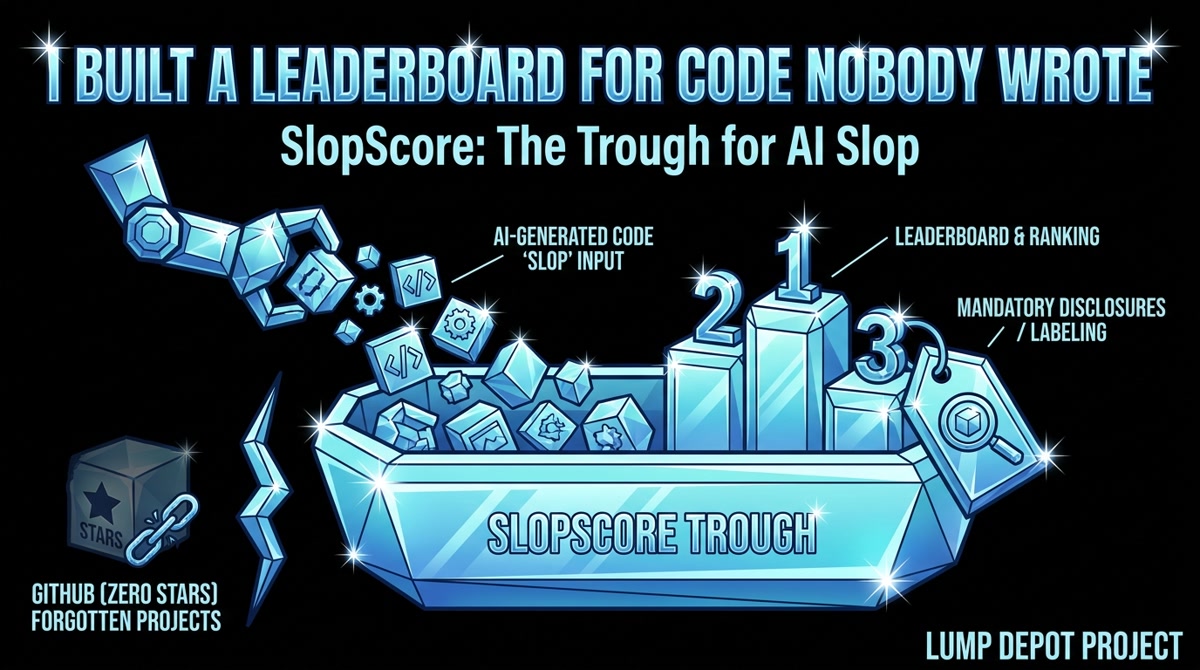
Back in April I wrote that everybody had opened a hot dog cart on the side of the road and was pretending it was a restaurant. I stand by it. The part I got wrong was assuming somebody would eventually line the carts up in one place so you could taste them next to each other.
Nobody did. So I built it. It's called SlopScore, and yes, the name is the joke.
Where slop goes right now
Picture the normal ending to a weekend. You sat down with an agent, described a thing, and now the thing runs. It's not a product. It's not going to hold up if a thousand people hit it. But it works, and you're a little proud of it.
Where does it go?
GitHub, where it sits at zero stars until the heat death of the universe. Trending is for projects that already won. Half the relevant subreddits ban AI-generated project posts outright, and the ones that don't will dunk on you for sport. You can put it on X and get a twenty minute half-life and three bot replies about growth hacking.
So the maker gets no feedback, ever, on the thing they just spent two days making. And anybody who actually wants to browse this stuff has no way to find the handful that are any good. Same problem, viewed from both ends.
The rule is: mock the genre, never the maker
This was the part I had to get right before writing any code, because a site called SlopScore could very easily be a bullying machine.
The genre is fair game. It's inherently funny that we're all shipping weekend projects written by a machine that also wrote the tests that say the weekend project is fine. The person who shipped it is not fair game. They did the thing everybody in the industry is currently doing, and at least they said so out loud.
Which gets me back to a thing I keep banging on about: labeling. I asked a few months ago how many carbs a book has, and I want the same nutritional panel on a repo. Not "AI or not AI," which is a useless binary that makes people lie. Something specific.
So the disclosures on SlopScore are mandatory and they're structured. How much of it was AI generated: entirely, mostly, partly, none. How much human touch: none, light, heavy. What it contains, what state it's in, whether it phones home. Leave a required field out and the repo gets rejected, with the reason printed in public on its own page.
That makes the site honest by construction. Nobody's guessing how much of your project the model wrote, because you told them, and the thing you told them is the ticket in.
How it works, in three sentences
You commit one file called slopscore.md to the root of a public repo. A crawler finds it, validates it, and lists you. People vote and argue in the comments.
No form. No account. No app to install. Here's the whole file, this is not a trimmed version:
---
slopscore: 2
spec: https://slopscore.org/spec
ai_generated: entirely
human_touch: light
content_rating: everyone
contains: []
category: [cli]
status: works-on-my-machine
---
Everything else comes from the GitHub API, because the file should only hold what GitHub can't tell me. Name, description, language, topics, stars, README: all of that I can just go get. Asking you to retype it would be rude and it would also go stale.
There's a pile of optional stuff if you want to be found by it. What you built it with, what models, what it runs on, who it's for. You can also file yourself into a "slopbucket," which is a subreddit-shaped feed, and if the bucket you want doesn't exist, writing it in the file creates it.
The thing that wrote it can list it
Here's my favorite part, and it's the reason I think this works at all.
The agent that generated your project can add the file itself. There's a URL, slopscore.org/skill.md, that serves a valid drop-in skill. Point any agent at it and it knows to ask you first, write honest disclosures instead of flattering ones, commit the file, and hand you back the listing URL.
The slop machine files its own paperwork. I don't know what to tell you, that's where we are now, and I'd rather be standing where it lands.
About the repos I went and got
Most of what's listed today, I found. There's a crawler that sweeps GitHub for repos whose READMEs proudly announce a model wrote them, and it hauls them in and grades them. I'm not going to be coy about that, because it's the kind of thing you should hear from me and not notice on your own.
The rules I gave it: public repos only, nothing that isn't already announcing itself, and one click gets you out. Put unlisted: true in a file, or press the button, and you're gone on the next pass. The alternative was launching a leaderboard with eleven entries on it, all mine, which is not a leaderboard. It's a diary.
What it costs to run
One Cloudflare Worker, one D1 database, and Workers AI doing the content gates. About six dollars a month, and most of that is a domain amortized badly.
It was built with the same tools it grades, in the same way, on a plan I wrote in an afternoon. It's listed on itself. It scored what it scored and I left it there.
The moderation stack, briefly
Someone always asks, so: votes carry a trust weight pulled from GitHub signals, so a week-old account with no history doesn't get the same pull as somebody with five years of commits. There's a vote-ring check that zeroes out bursts coming from accounts that all showed up on the same day. Comments go through Llama Guard. Anything that looks like an attack gets counted, and repeat probes get shut out for a day.
Every one of those is a flag in a single environment variable, which means I can turn any of them off without redeploying code, and I can tell you exactly which ones are on. The queue and the moderation log are public pages. You can watch it work, or watch it fail.
That was deliberate. A site whose entire pitch is "disclose things" would look pretty stupid with a secret ranking algorithm.
Go put something in the trough
It's new, so it's quiet. Early listings get read, which is more than your repo is getting at zero stars on GitHub right now.
The file is eight lines. slopscore.org/orphanage explains the joke and what happens after. If you'd rather not read anything, commit the file and wait.
tl;dr: the hot dog carts are everywhere and nobody built a place to line them up, so I did. SlopScore is peer review for code nobody wrote. You opt in by committing one file to a public repo, the disclosures in it are mandatory so the whole thing stays honest, and your agent can add the file for you. Mock the genre, never the maker. Runs on one Worker for six bucks a month and it's listed on itself.