 LUMP Depot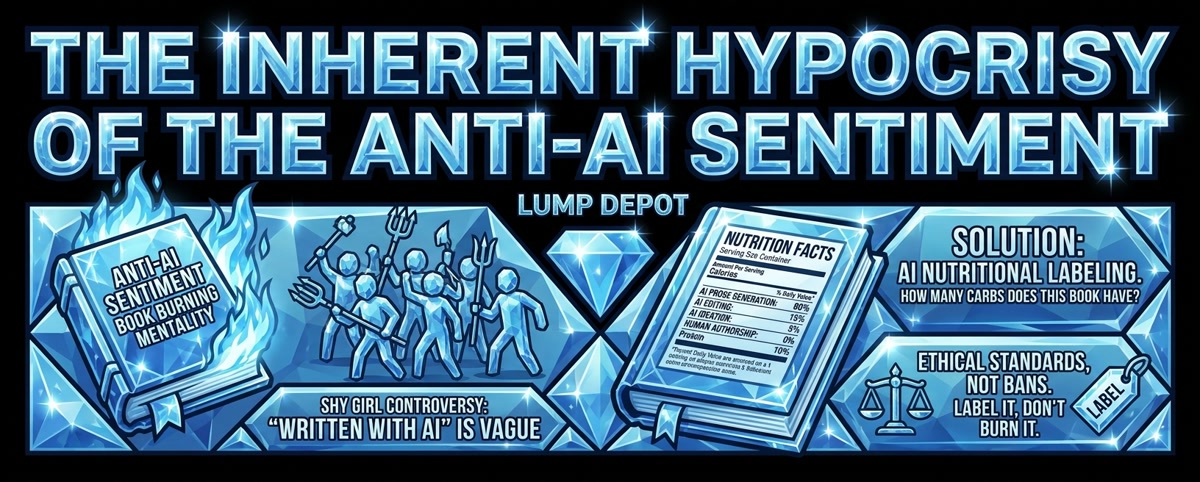
Do you think it's OK to burn or ban books that you find objectionable?
Sit with that for a second. Because the conversation around AI in publishing has started to feel a lot like a book burning, and I don't think most people realize it.
What happened with Shy Girl
An author self-published a book called Shy Girl. It was criticized for being AI-generated or AI-assisted. The cover was taken from Pinterest, allegedly under the assumption it was fair use. Whether the original artist was ever compensated isn't clear from the reporting, but that's a separate issue. The book got picked up by a major publisher, hit a wall of backlash over the AI question, and was pulled.
It's worth noting: the author's stated defense was that a freelance editor introduced AI-generated elements into her manuscript without her knowledge, and she's pursuing legal action against that editor. I'm not here to litigate whether that's true. But it matters to the conversation, because even the person at the center of this isn't saying "yes I used AI and it's fine." She's saying the AI involvement was unauthorized. That should tell you something about where the cultural line currently sits.
I watched a lot of videos about this situation. The phrase that kept coming up was "written with AI." And for a community of writers, that's a surprisingly vague term.
Does "with AI" mean the AI wrote it? Was the AI within 100 meters of your location while you were typing? Did you ask it to fix a comma splice? Did you have it rewrite your entire third act? There's a massive gap between using AI editorially and using AI to generate prose, and nobody in these discussions seemed interested in defining where the line actually sits.
How many carbs does this book have?
Here's where it gets interesting. You can walk into any bookstore and buy Mein Kampf. You can buy Maus. You can buy any number of divisive, controversial, morally complicated books. Nobody stops you. You pick the amount of content you're comfortable with based on your own judgment.
So why can't we do the same thing with AI-assisted books?
The issue isn't really about whether AI should be used. The issue is labeling. Tell me how many carbs this book has and let me decide if I want to eat it. Right now there's no nutritional label. There's just a mob with pitchforks and a binary question: AI or not AI?
That's not useful. We need a new set of ethical standards, or at least a shared vocabulary, so people can pick the amount of AI they're personally comfortable with. "AI-assisted" should mean something specific. "AI-generated prose" should mean something different. "AI-edited" should be a third category entirely. Instead we've got one label and a lot of yelling.
Where I actually stand
I want to be clear about my own position here, because this isn't a defense of AI slop.
The problem with AI-generated prose is that it's built on theft. The training data was scraped without consent, without compensation, from writers who never agreed to have their work digested by a language model. I'm not arguing that point. It's real and it matters.
My personal opinion is that all prose should be written by the author. Your words, your voice, your sentences. That's the craft. That's what readers are paying for.
But I think editorial assistance from AI is a different conversation, for one very important reason: if you hire a human editor, you have no idea whether they're running your manuscript through these tools before sending back notes. You'd be foolish not to pre-screen your own work with the same tools they might be using. I wrote about this recently: anything you share with a person is one paste away from a model. Your editor's workflow is a black box to you.
That doesn't mean you skip the human editor. You absolutely still need one. You still need human test readers. The AI catches patterns. Humans catch meaning.
The asymmetrical battle
Here's the part nobody wants to hear. As an author, you are going to compete against these machines whether the industry admits it or not. Some people are using AI to generate entire books. Some are using it to polish. Some are pretending they don't use it at all. You don't know which is which, and you won't unless the labeling problem gets solved.
Trying to win an asymmetrical battle has always been the most costly road. You can fight it on principle. You can refuse to touch the tools. But you're choosing to bring a typewriter to a gunfight while half the other writers are quietly loading their magazines.
Saying "we all hate AI, stop using it in books" is a form of sticking your head in the sand. As much as I'm literally right there with you.
(A pun!)
Labels, not bans
The answer isn't to ban AI from publishing. That ship sailed when the first writer pasted their draft into ChatGPT to check for pacing issues. The answer is transparency. Tell readers what they're buying. Let them make informed choices. Build a standard that distinguishes between "a human wrote every word and used AI to catch typos" and "an AI wrote this and a human fixed the grammar."
We do this with food. We do this with financial disclosures. We do this with content ratings on movies. The publishing industry can figure out a label.
Until then, pulling books off shelves because they might have been "written with AI" is just book burning with better PR. And if you're a writer who cares about the freedom to publish, that should bother you regardless of how you feel about the tools.
tl;dr: the tools are inevitable. The theft problem is real and needs addressing. But the answer is labeling, not banning. Tell me how many carbs are in the book and let me decide for myself.